Djinguereber Mosque in Timbuktu, Mali
Photo Timbuktu assets/timbuktu.jpg
Cultural heritage · Mali

Timbuktu

World Heritage since 1988 · In Danger since 2012

The old caravan city on the southern edge of the Sahara was, in the 15th and 16th centuries, an intellectual metropolis of Africa — seat of Sankoré University with 25,000 students and a library of thousands of manuscripts. Three great adobe mosques, sixteen saints' mausoleums.

When Islamist militias occupied the city in 2012, they destroyed fourteen of the sixteen mausoleums with picks and chisels. Courageous citizens smuggled hundreds of thousands of manuscripts to Bamako in donkey carts. Today Timbuktu is once again under state control, but the threat from armed groups persists — and the sand of the desert advances further.

Historic centre of Vienna with St. Stephen's Cathedral
Photo Vienna assets/wien.jpg
Cultural heritage · Austria

Vienna

World Heritage since 2001 · In Danger since 2017

The historic centre of Vienna — Habsburg residence, the city in which Mozart worked, setting of the Congress of Vienna — was inscribed as World Heritage in 2001. A coherent urban silhouette in which the Gothic towers of St. Stephen's Cathedral and the Baroque Hofburg complex set the scale.

Yet a planned high-rise project at Heumarkt — exceeding the height the World Heritage Committee had defined as the upper limit — led UNESCO to place Vienna on the red list in 2017. The example shows that danger does not come only from war or climate. Even a prosperous democracy can lose its heritage when economic interests outweigh the protection of the cityscape.

Galápagos Islands, Ecuador
Photo Galápagos assets/galapagos.jpg
Natural heritage · Ecuador

Galápagos Islands

World Heritage since 1978 · In Danger 2007–2010 (successfully rescued)

The very first site ever inscribed on the World Heritage List — Charles Darwin's "living laboratory of evolution". Giant tortoises, marine iguanas, Darwin's finches. In 2007 UNESCO placed the archipelago on the red list: explosive tourism, illegal fishing, and introduced animal and plant species threatened the unique ecosystem.

Ecuador responded with determination — strict entry restrictions, the expulsion of illegal settlers, and a courageous quarantine programme. As early as 2010 UNESCO removed Galápagos from the red list. One of the few success stories — and proof that the World Heritage instrument works when the political will is there.

Adobe reliefs at Chan Chan, Peru
Photo Chan Chan assets/chan-chan.jpg
Cultural heritage · Peru

Chan Chan

World Heritage and on the red list since 1986

The largest adobe-brick city of the pre-Columbian world: Chan Chan, once the capital of the Chimú empire on Peru's desert coast, housed an estimated 60,000 people in the 15th century. Nine walled palace complexes, kilometre-long relief walls with stylised pelicans, fish and geometric patterns.

In the very year of its World Heritage inscription, 1986, Chan Chan was placed on the red list — because of ongoing natural erosion. Adobe has one enemy: water. The El Niño phenomenon brings increasingly heavy rainfall. What endured for 600 years now melts away by the hour. A reminder that even without war and without malice, heritage can disappear.

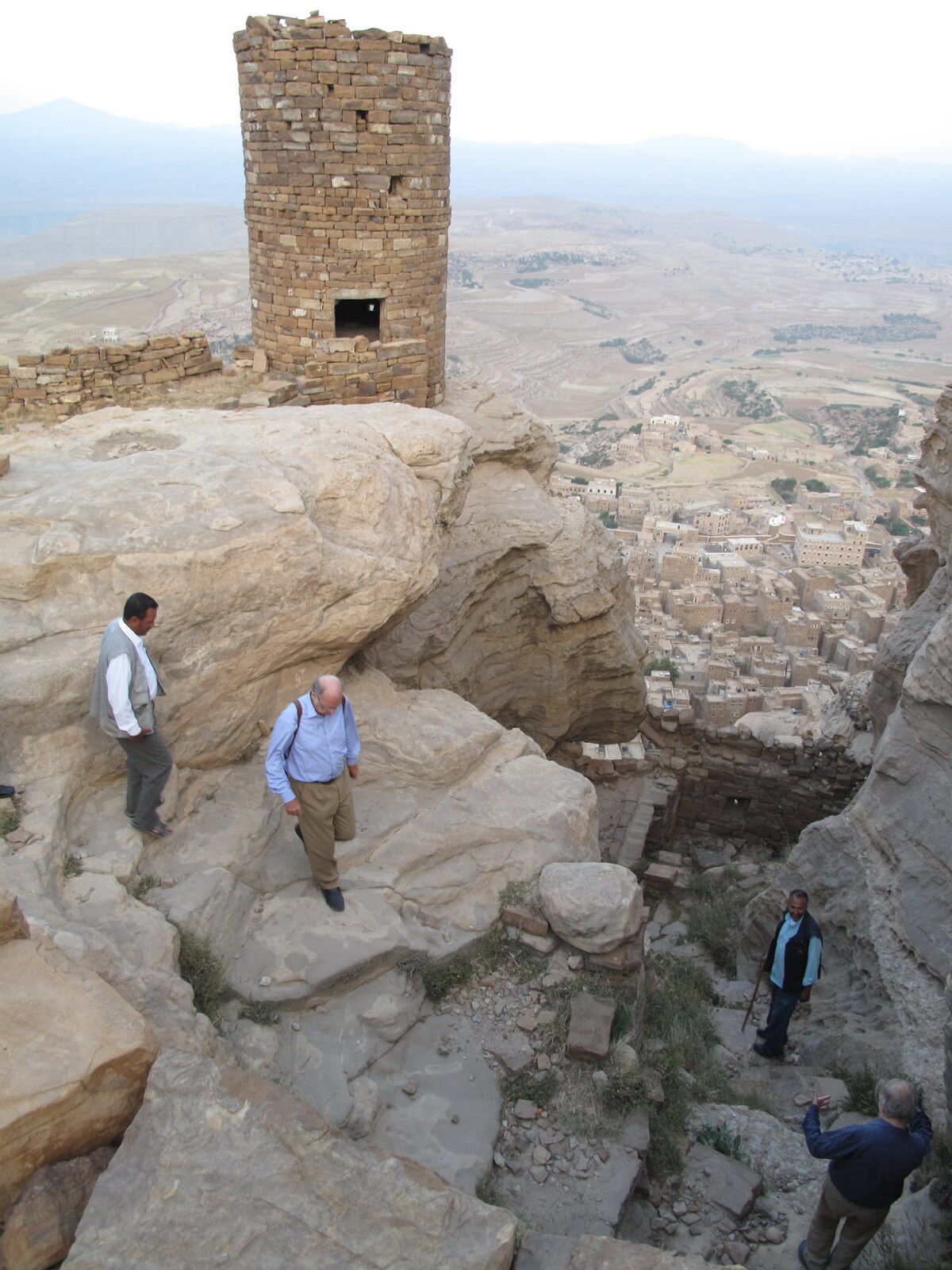
Bernd von Droste in Yemen, 2010
On the ground, where world heritage is threatened Bernd von Droste in Yemen, 2010 — a country whose historic cities of Sana'a, Shibam and Zabid are today inscribed on UNESCO's List of World Heritage in Danger. For half a century his missions took him to the most endangered places of our shared heritage.

Altogether 53 sites are inscribed on UNESCO's List of World Heritage in Danger. You can find them all on the interactive world map.